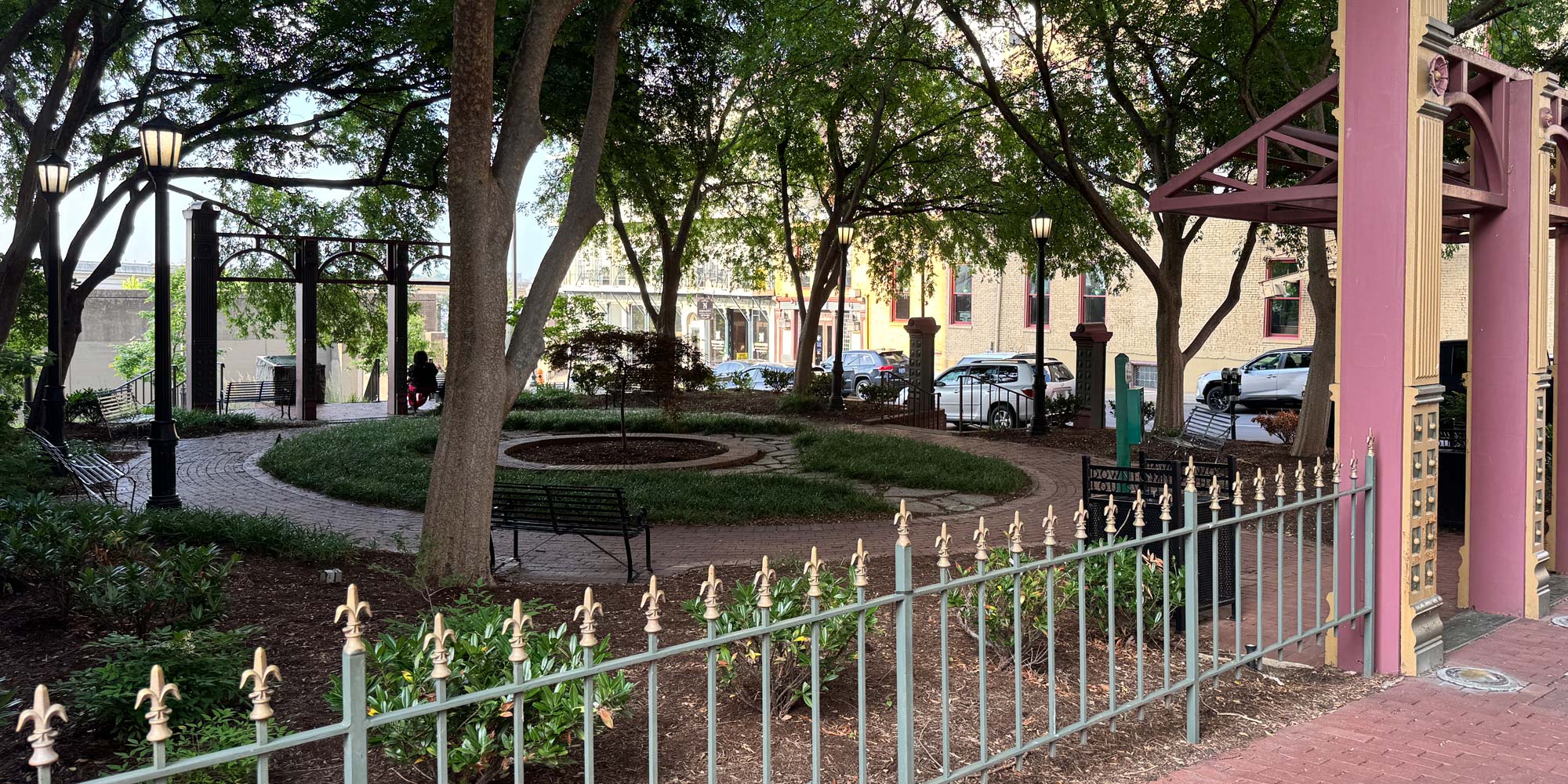
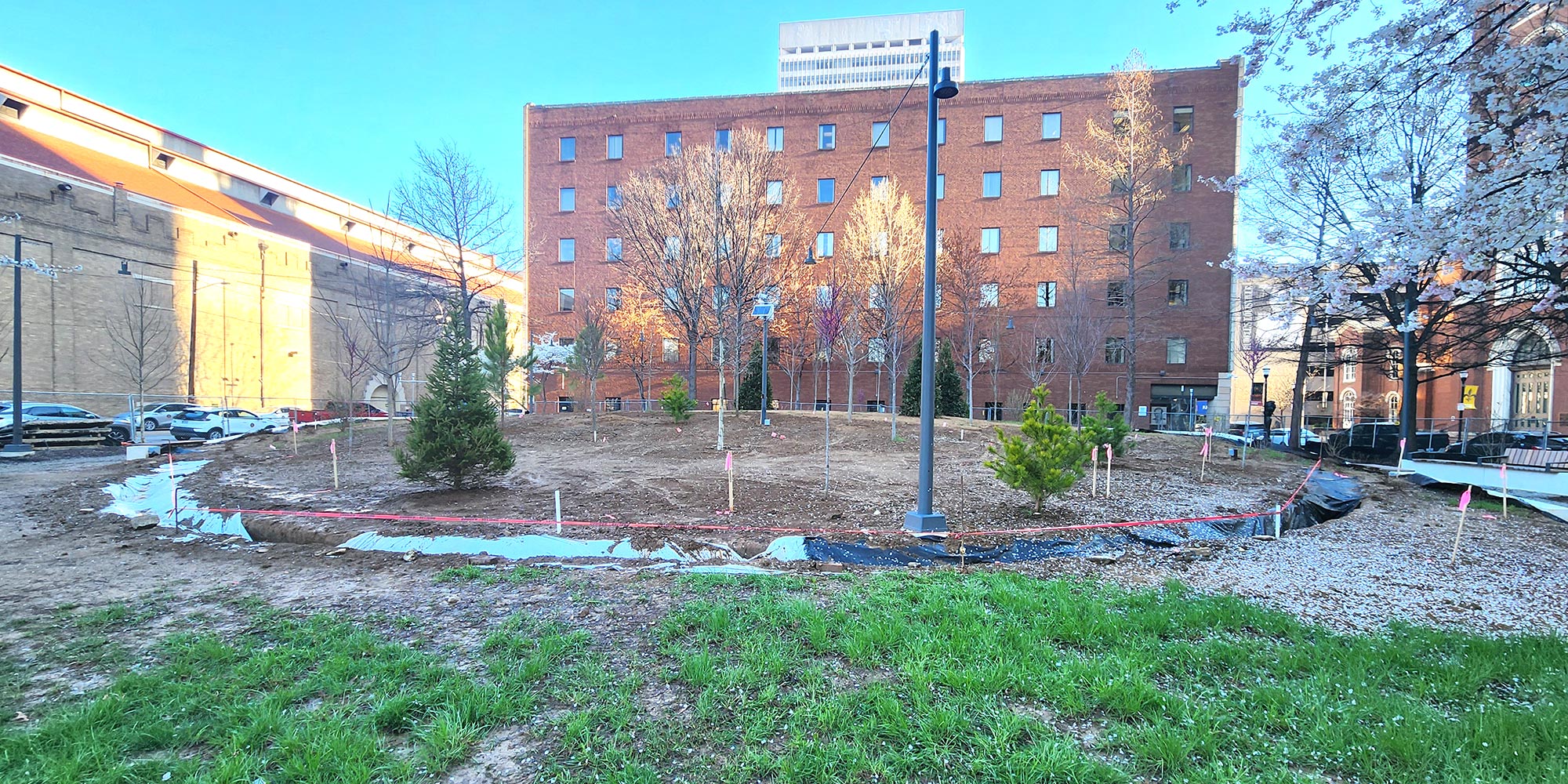
Today is Park(ing) Day, an international celebration where cities around the world transform parking spaces into temporary public spaces. In Louisville, The Urban Design Studio previously coordinated the event from 2010 to 2013. Over the past few years, the Louisville Downtown Partnership has taken up the mantle. Previous Park(ing) Days saw downtown parking spaces taken over for miniature green spaces, breweries, conceptual streetcar stops, and more. These transformations show the power of small spaces in an urban environment and how much of our cities are dedicated to car parking. In celebration of Park(ing) Day, we wanted to quantify the extent to which the latter is true in Louisville.
Downtown’s Parking Abundance
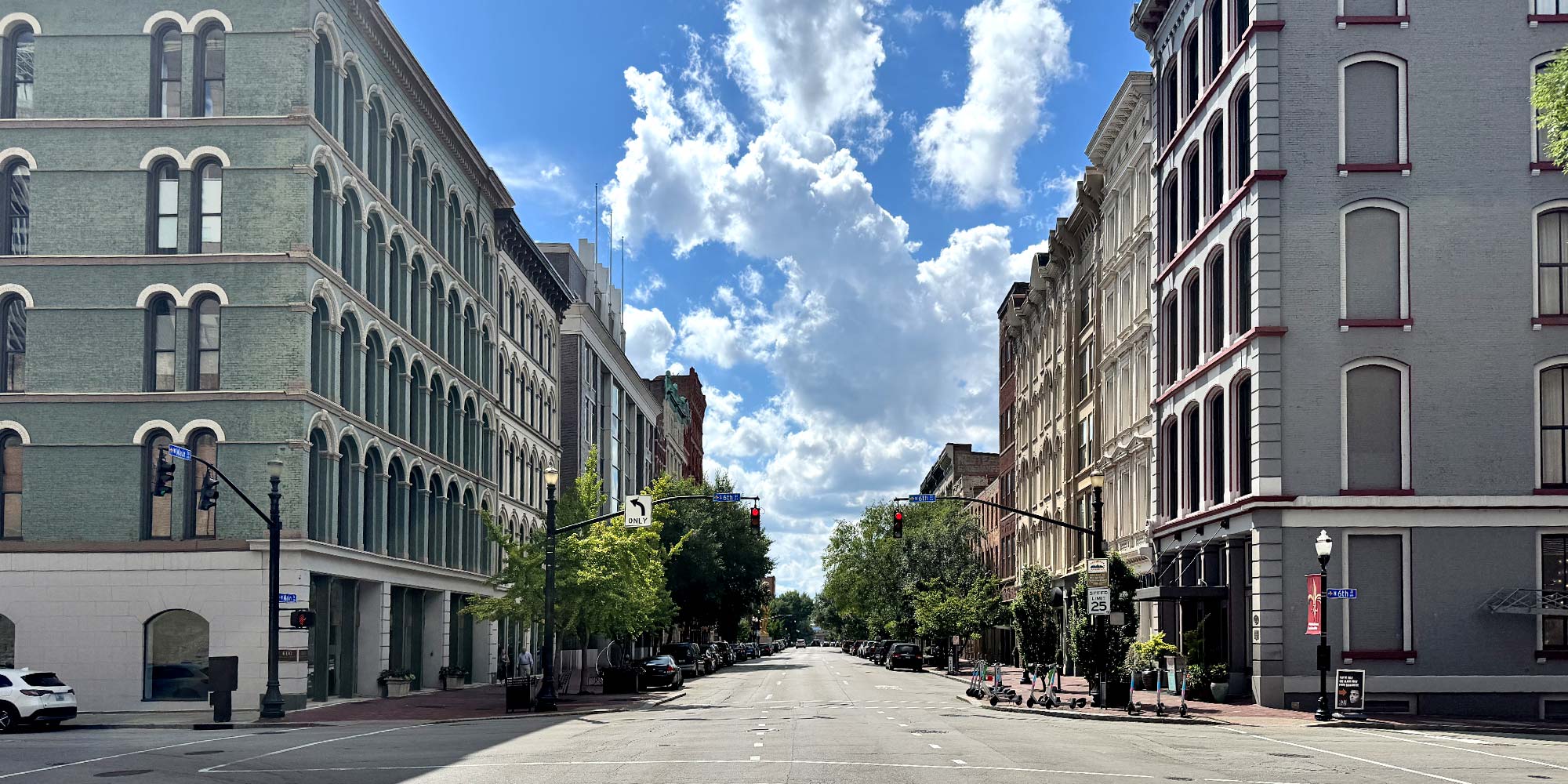
Park(ing) Day generally focuses on downtown areas and adjacent neighborhoods. The Louisville Downtown Partnership is currently the primary proponent of the celebration, gathering twenty participating organizations to take over parking spaces downtown; only the Urban and Public Affairs Student Association is hosting any event outside of the downtown core. This is in part because it is usually logistically the simplest to do these events in areas with a high density of people and businesses, but also because the scars left by excessive parking are most visible in Downtowns.
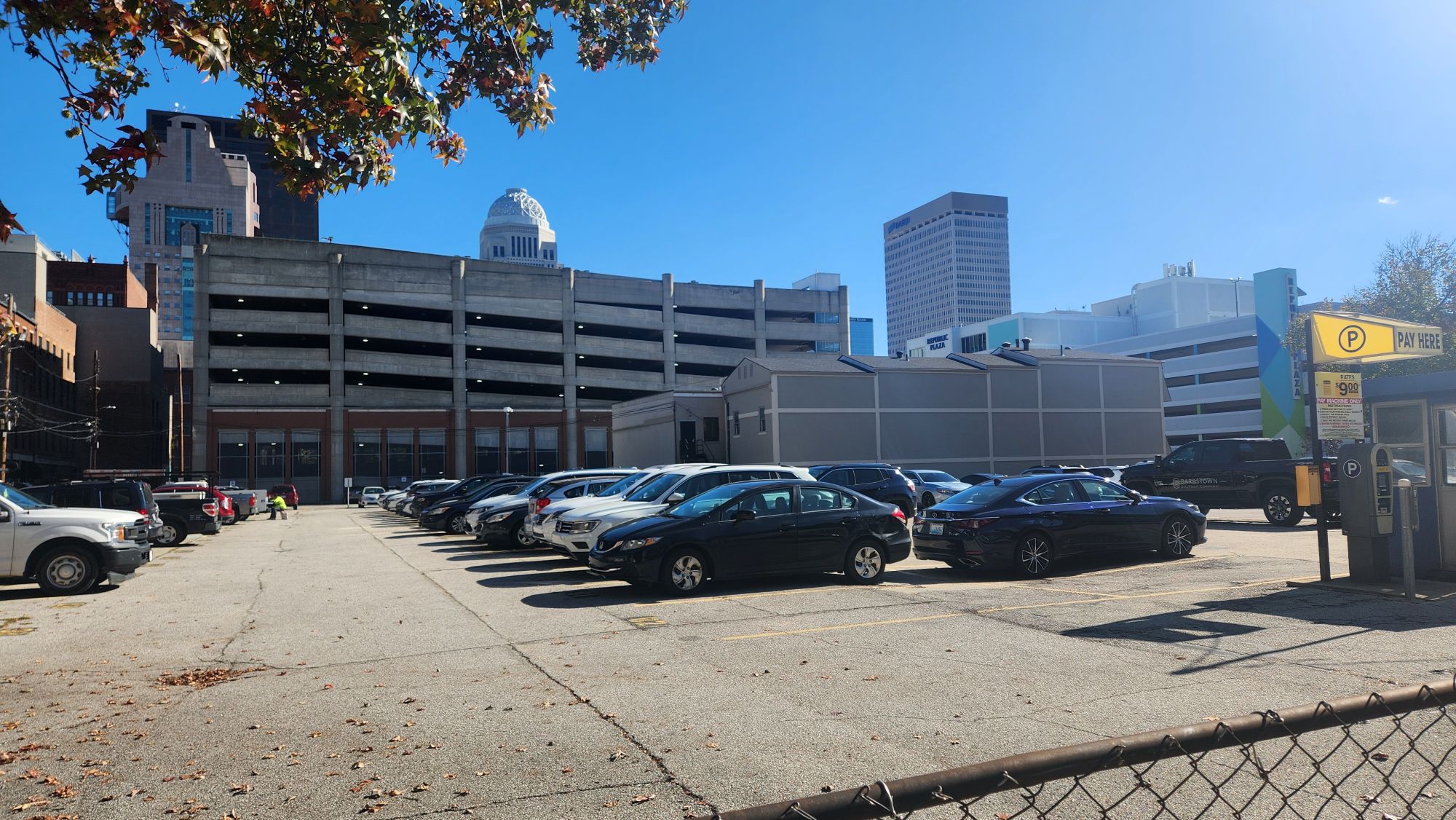
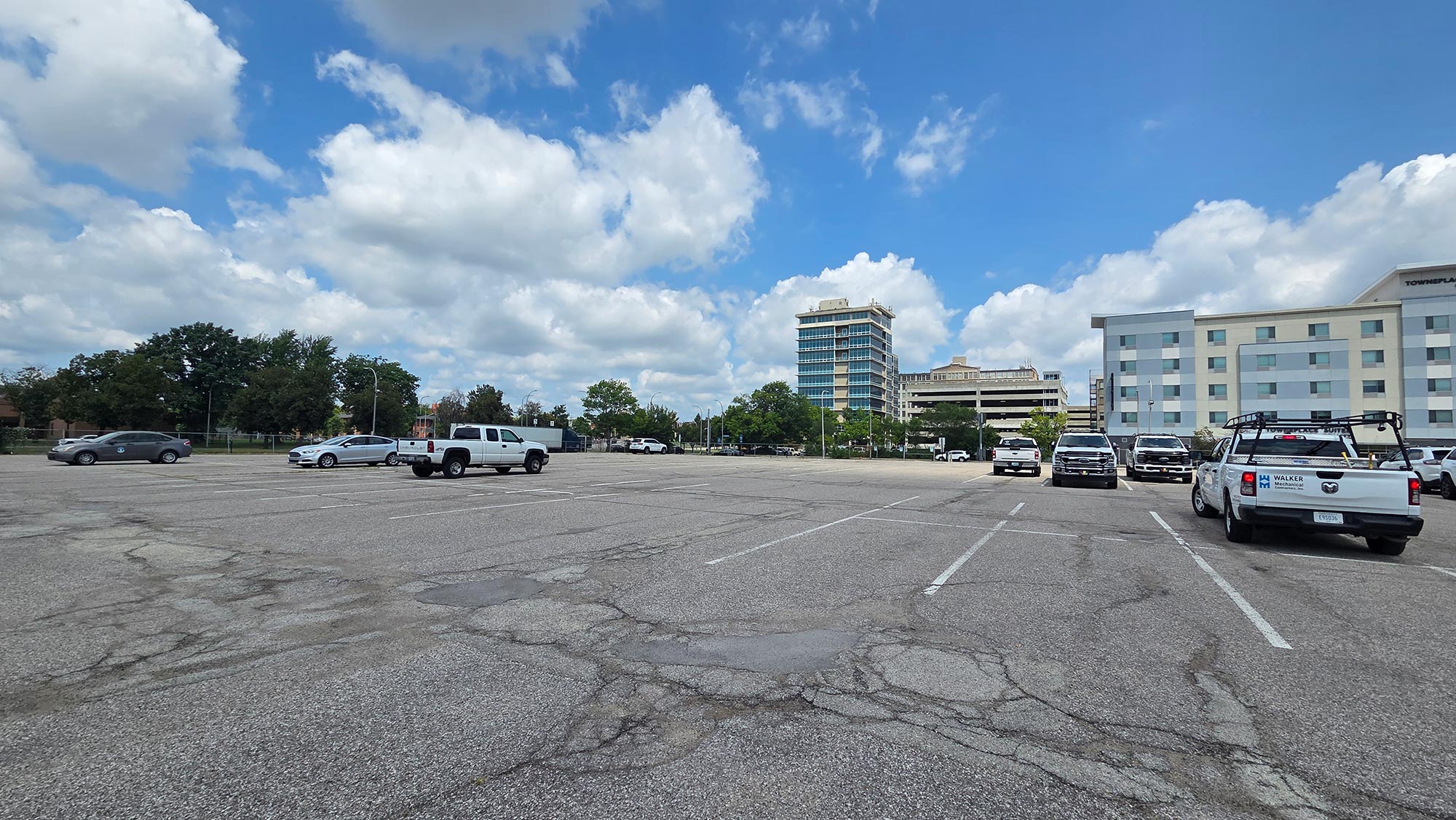
The primary culprit creating these scars is surface parking, which takes up large swathes of the Central Business District. These lots come with a wide range of negative externalities. They are the primary creator of “missing teeth”, where the flow of downtown urban form is broken by the presence of parking/vacant lots between structures. Missing teeth may just sound like an ugly necessity, but these lots can also act as a barrier to walkability, economic development, and urban vitality. The environmental effects of excess surface parking are more extreme, as an overabundance of impervious surfaces contributes to increased flooding, urban heat [2], and groundwater pollution. Flooding and urban heat, in particular, will only get worse as global temperatures rise [2], increasing instances of related mortality and morbidity.
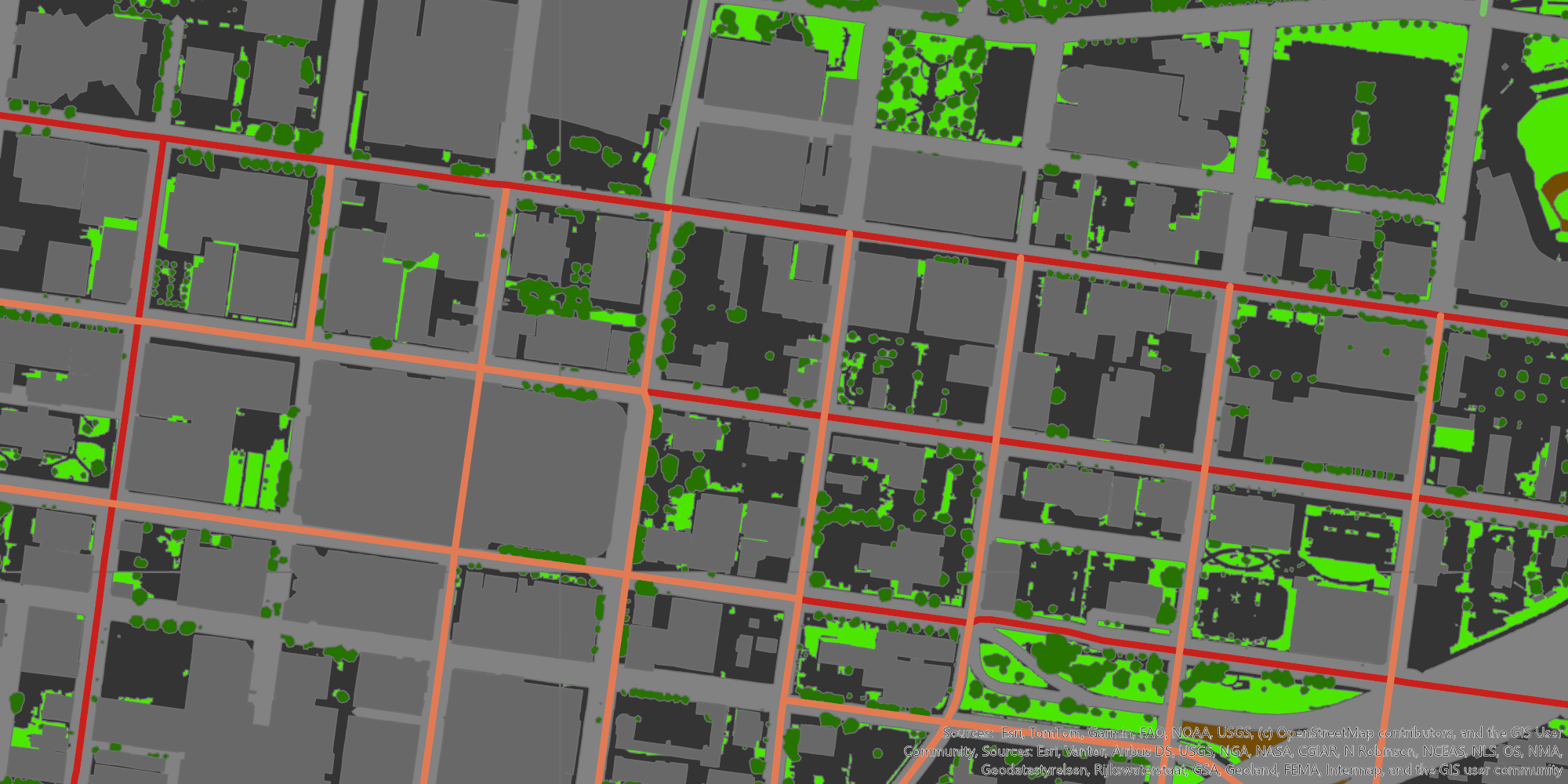
We also need to understand the scope of the problem. Downtown is where the effects are most pronounced and easiest to quantify. The Urban Design Studio previously conducted a parking inventory as part of our Open Space Network Study last year. Following a brief update, the *conservative* estimate from the inventory puts downtown’s estimated number of parking spots at 43,150. This includes surface lots, garages, and metered street parking. It is a conservative estimate since there are likely a handful of unmetered locations and hidden lots not included. Esri, extrapolating from the most recent census data, estimates that Downtown currently has a residential population of 3,722 and a daytime population of 42,391 (note that daytime population includes basically any visit downtown between 9 am and 5 pm). Meaning there is about one space per visitor, assuming every person drives downtown, and 11 spaces per resident. The per resident number is also very conservative, since downtown population numbers include the now empty Dosker Manor towers (~600 residents) and the downtown jail population (which is 1507 the day this is being written). This means the real number of downtown parking spaces per resident may be as high as 27. To put further numbers to the parking total, a previous analysis we did indicated that 21.55% of downtown's total area was covered by surface parking alone.
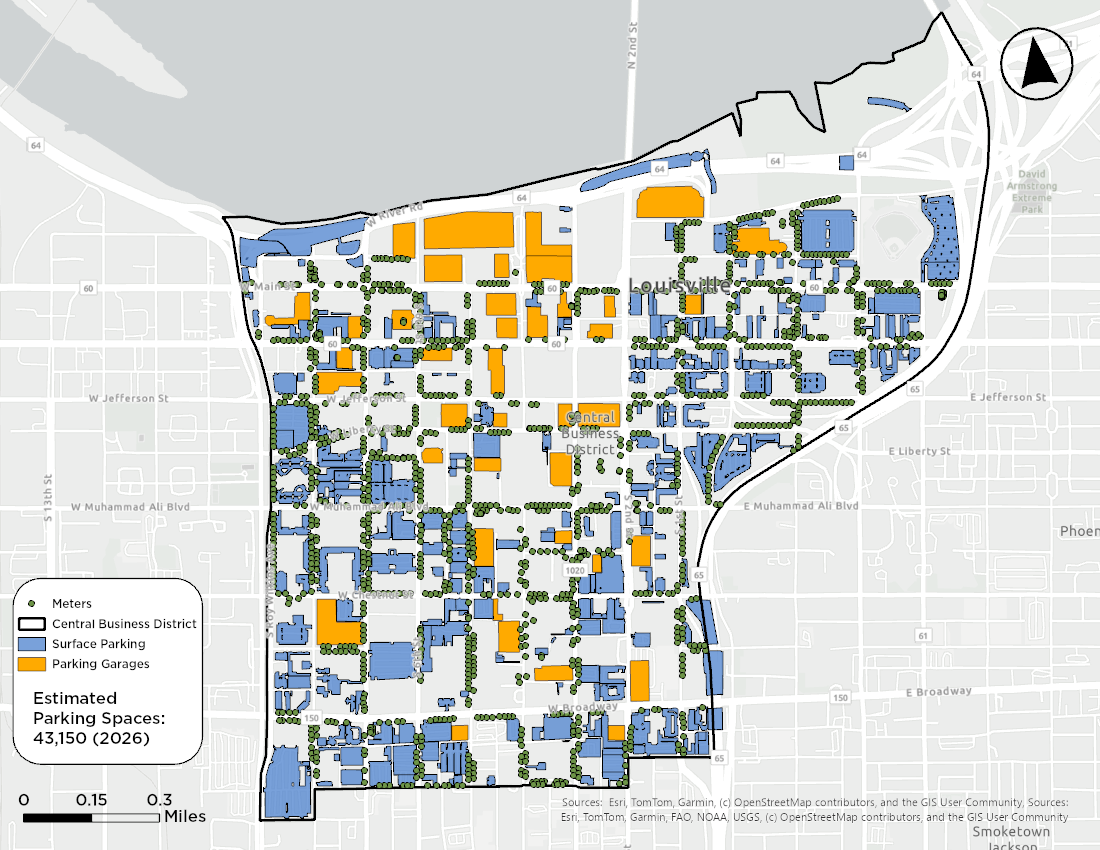
Parking in Downtown Louisville, 2026
Parking in Louisville as a Whole
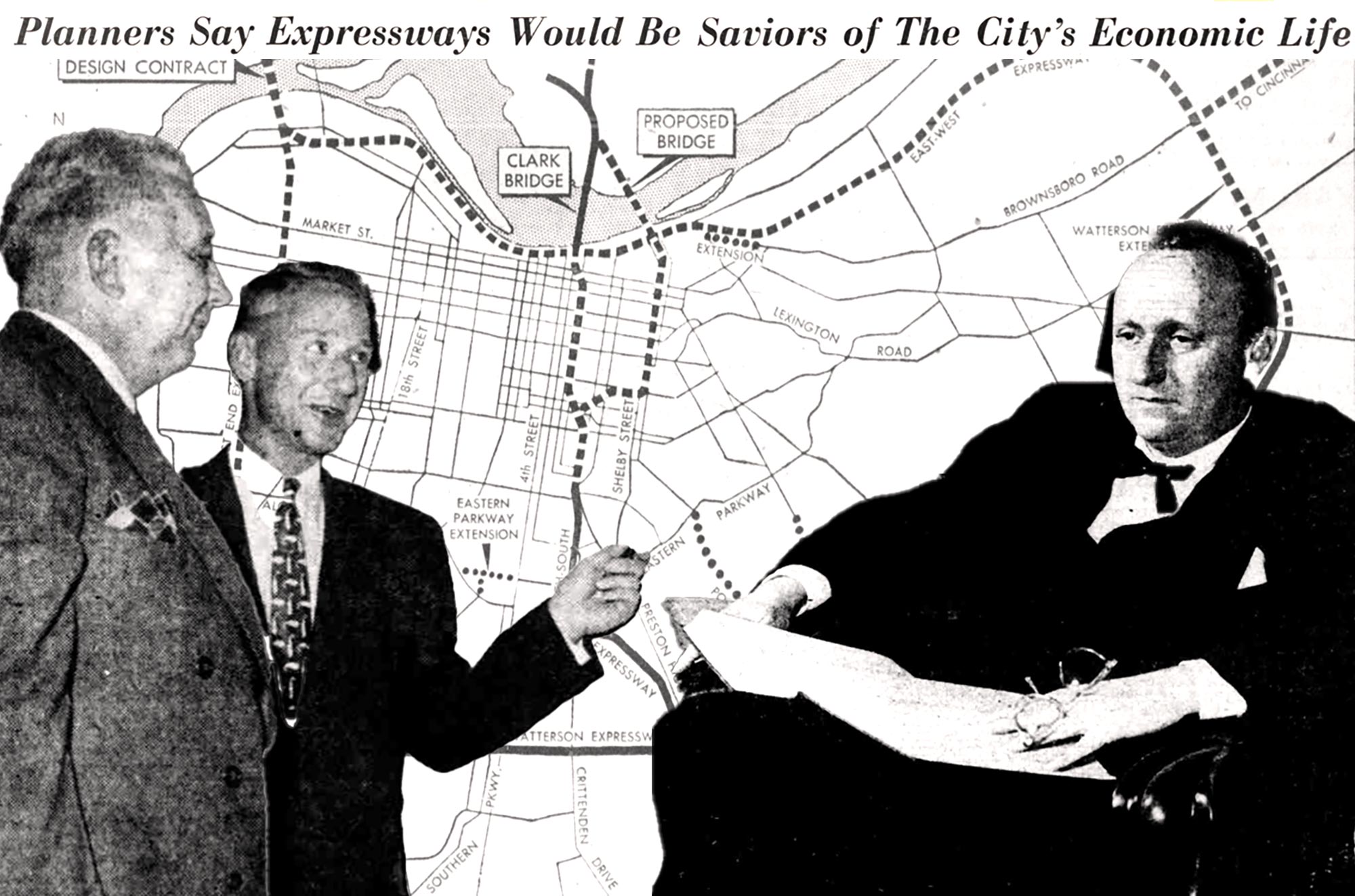
Louisville's built environment, like most North American cities, is designed around the car. 82% of Jefferson County residents commute to work by car, as do 78% of Americans overall. This car dependency has been the standard in the United States since the mid-twentieth century, as rail service and public transit options around the nation generally declined. This, along with suburbanization, has made parking a dominant fixture of the built environment in much of Louisville outside of downtown.
While parking is a common fixture, it is also much harder to calculate its quantity outside of downtown. There are no official data sources that inventory parking lots, garages, or meters outside of the Central Business District and a couple of nearby neighborhoods. Luckily, we do have data on the location and total surface area of practically every parking lot in Jefferson County. This allows us to get an approximate number of surface parking spaces. Again, we will be estimating conservatively, assuming parking spaces are all relatively large (400 square feet for each stall and space for drive lanes). In reality, parking spaces can be tens of square feet smaller, with more space in a lot dedicated to parking.
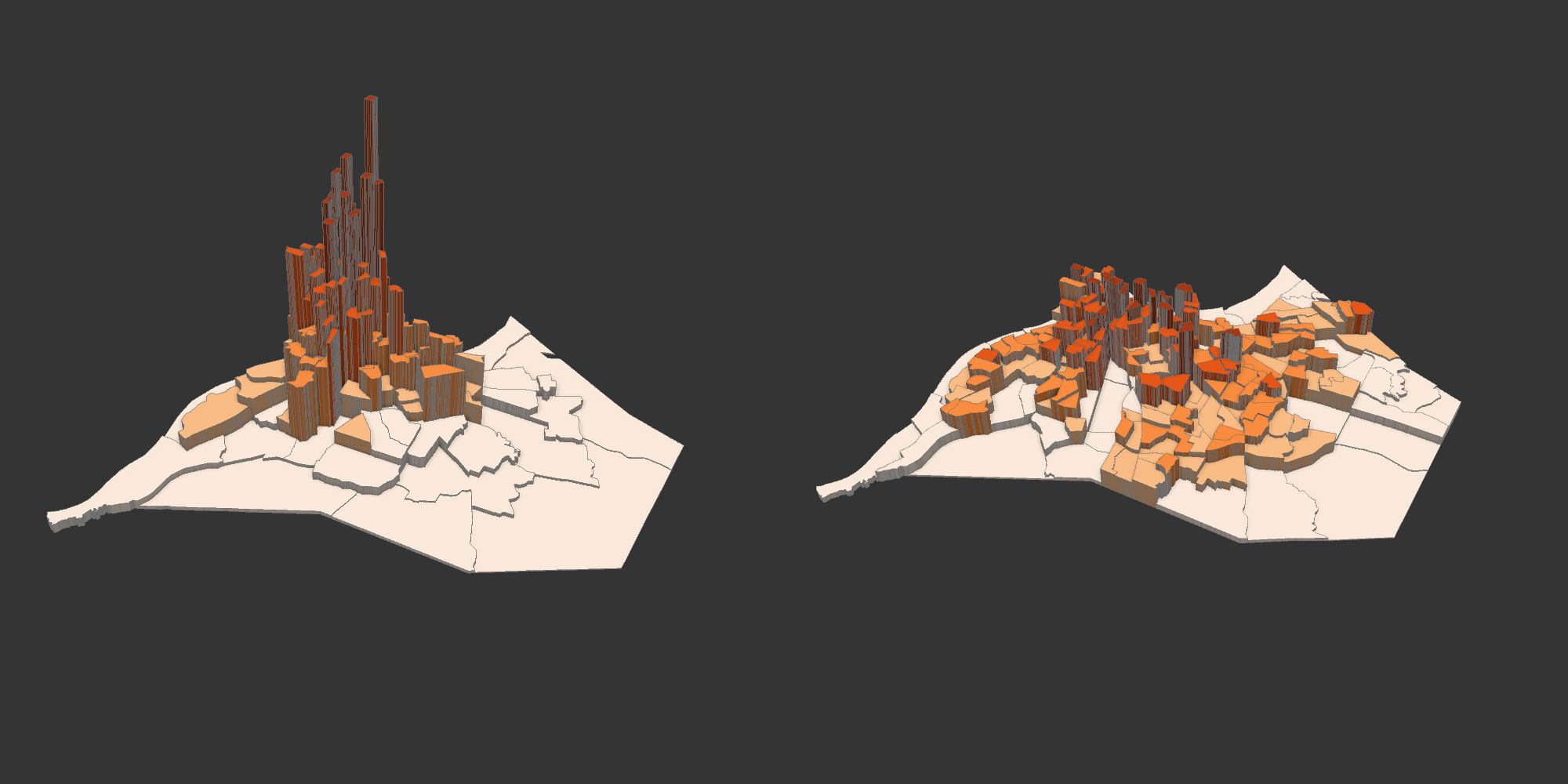
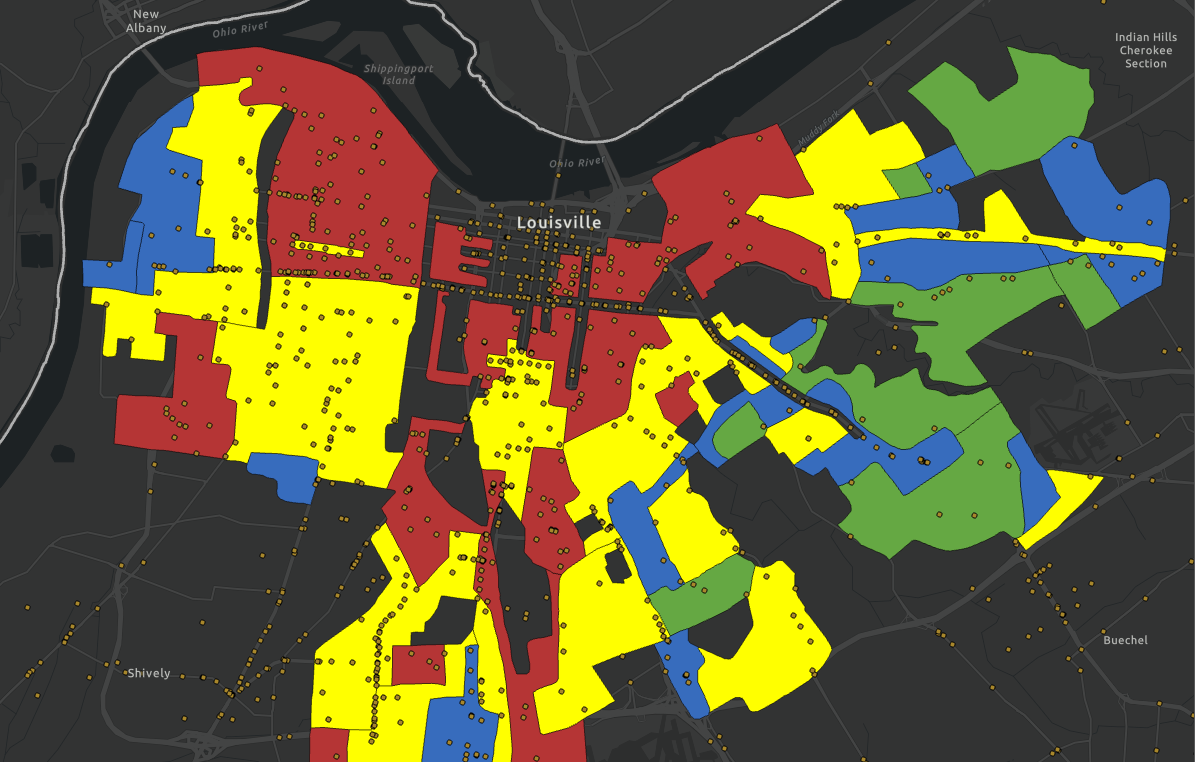
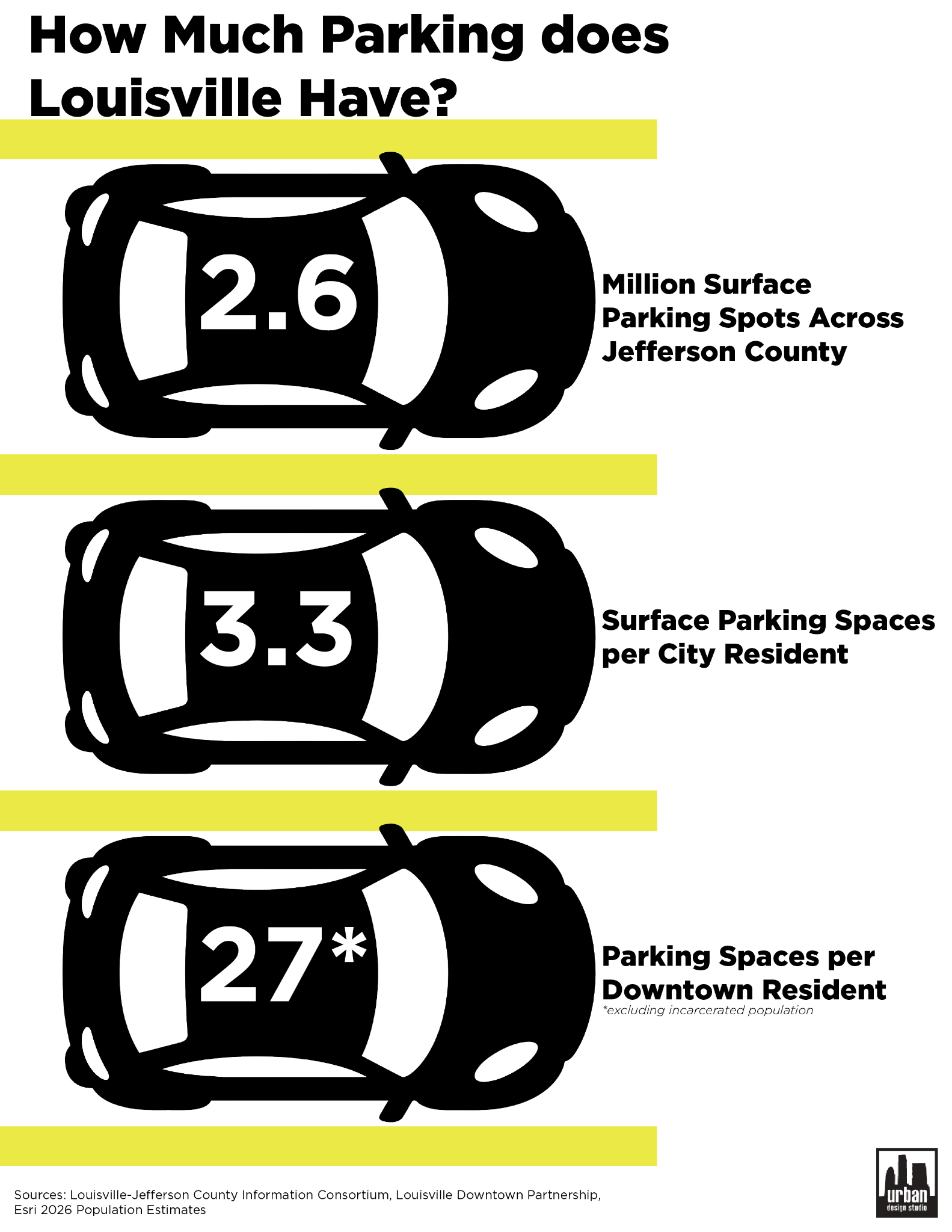
Under those assumptions, Louisville/Jefferson County has a minimum of 2,586,232 surface parking spots for 793,883 residents. This means we have about 3.3 surface parking spots per resident, including all non-driving populations such as children, bus commuters, etc. This varies quite significantly by neighborhood, from 21 per resident in parts of Jeffersontown to .6 per resident in Deer Park. The dichotomy between these neighborhoods can give you an immediate glimpse into their urban form, with areas like Jeffersontown having more parking-heavy big-box stores and industrial parks, whereas Deer Park is mostly dense residential and commercial that is more reliant on street parking. The full neighborhood-level map can be seen below. Details on each neighborhood can be seen by hovering over it.
Click here to view in another window
The infographic below summarizes the information in this article. Feel free to use it for future Park(ing) Day events or similar celebrations.
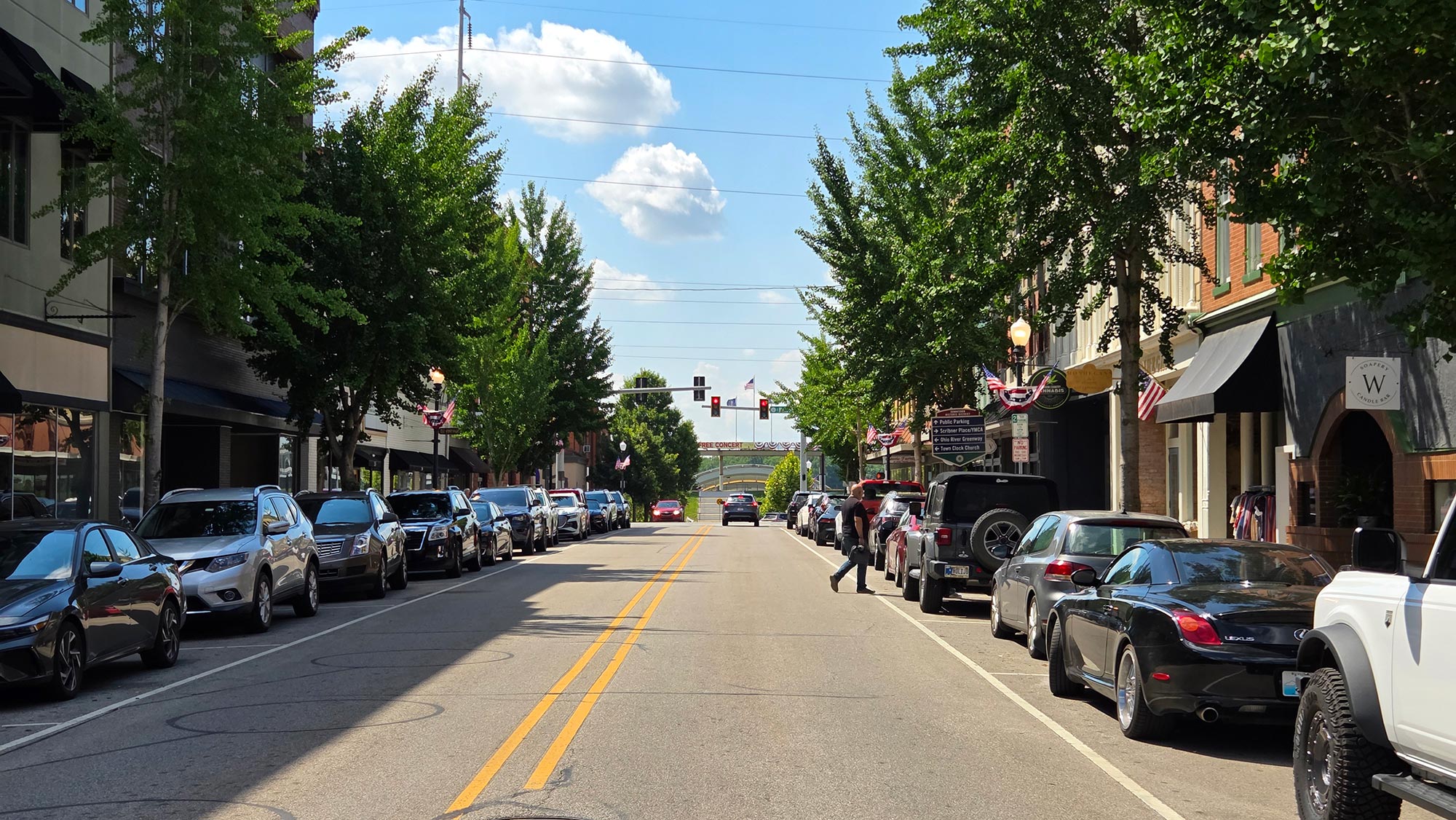
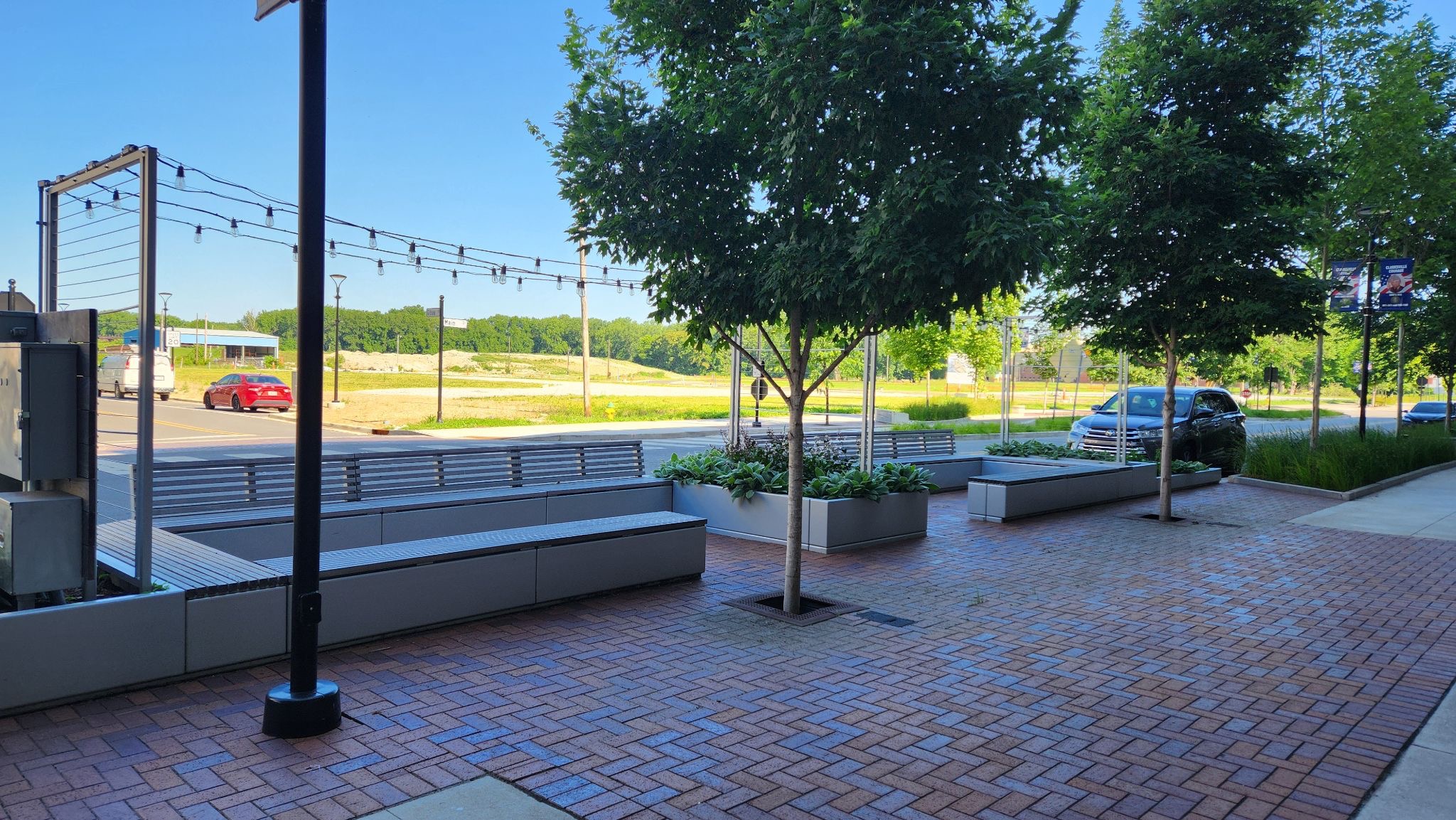
This all makes events like Park(ing) Day important, as it shows how these spaces can be activated, even at a small scale, to produce a more lively urban environment while also creating a healthier city. These celebrations have helped to popularize parklets and other small spaces, leading to them becoming more common in our built environment. If you want a great example, look across the river to Clarksville’s Main Street, which has several parklets integrated throughout its streetscape. As Park(ing) Day grows in Louisville, maybe we will see more of these spaces permanently established across the city.


.png)